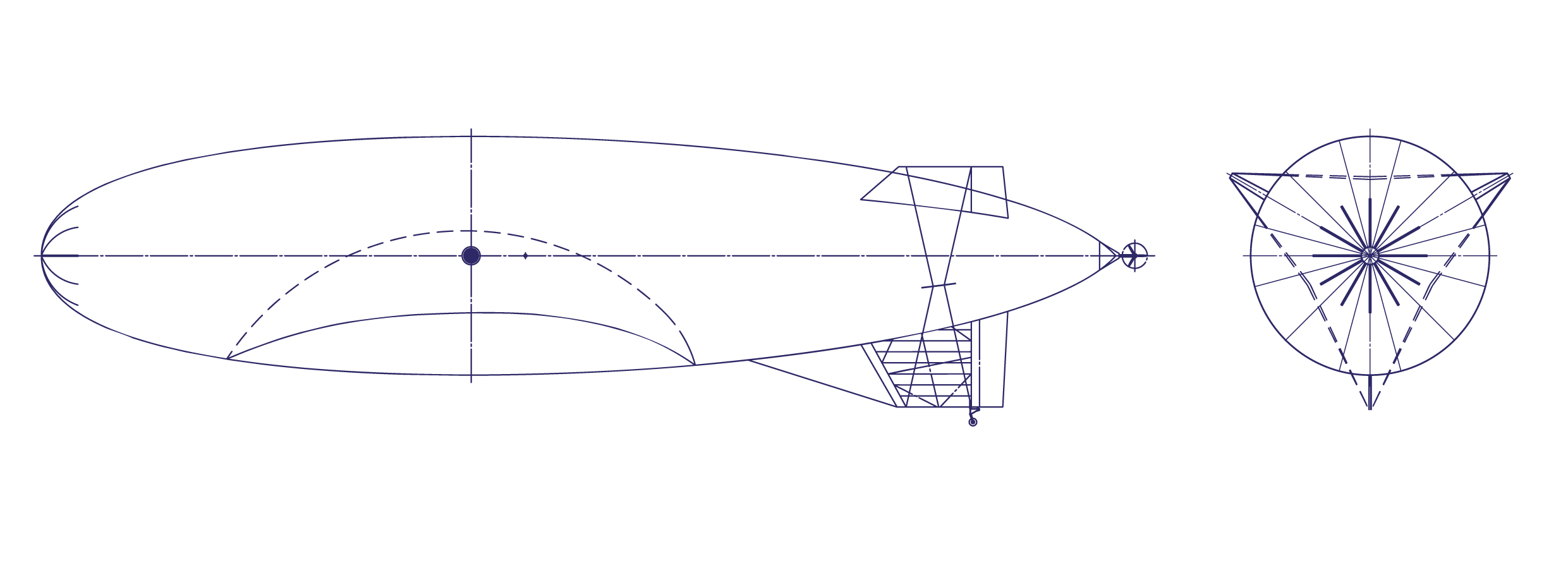
AERONOVA airship in flight.
AERONOVA · Next-Generation Airships

Opening the world.
Again.

Airships are coming back — not out of nostalgia, but as a working tool the world once set aside and now needs again. New logistics. The most remote corners of the planet. Cargo, supply, and connectivity where no other option reaches.

Flying today — not a render, not a concept.

Next
Idea

Why they disappeared — and why the time has finally come

The 1937 disaster became the symbolic end of an era. But the disappearance of airships had more than one cause. Safe helium was then available mainly in the United States, and many airships flew on explosive hydrogen; to that were added the technological limitations of the time, the rapid development of aircraft, and the Second World War — the priorities of the entire aviation industry shifted.

But the idea didn't disappear. It stayed, waiting for technologies that didn't yet exist.

This was transport that crossed the Atlantic with passengers a century ago and carried tens of tonnes of cargo. Today everything has changed — materials, electronics, control systems, the entire engineering approach. The same proven idea can be taken and elevated to a genuinely new technological level: what proved itself a century ago, made truly modern.

SafetyNon-flammable helium
TechnologyNew materials
DemandReal-world need
Proof

Not a render. Already flying.

This is the one place we prove rather than promise. Two real aircraft, built and flying — every flight is work for the NOVA programme.

NOVA-01 in flight — AERONOVA experimental testbed. Flying today

NOVA-01 · experimental testbed

Dynamically similar model of NOVA-2

NOVA-01 is a dynamically similar model of NOVA-2: the same proportions, control geometry and propulsion layout. On NOVA-01 we validate the solutions that will go into the larger models of the line — control, autopilot, dynamic models, the onboard computer, communications, sensors and telemetry. Every flight directly advances NOVA-2 and the next-generation aircraft.

Specifications

Volume130 m³
Payloadup to 30 kg
Rangeup to 200 km
Speedup to 70 km/h
Altitudeup to 1,000 m
Loiterup to 24 h
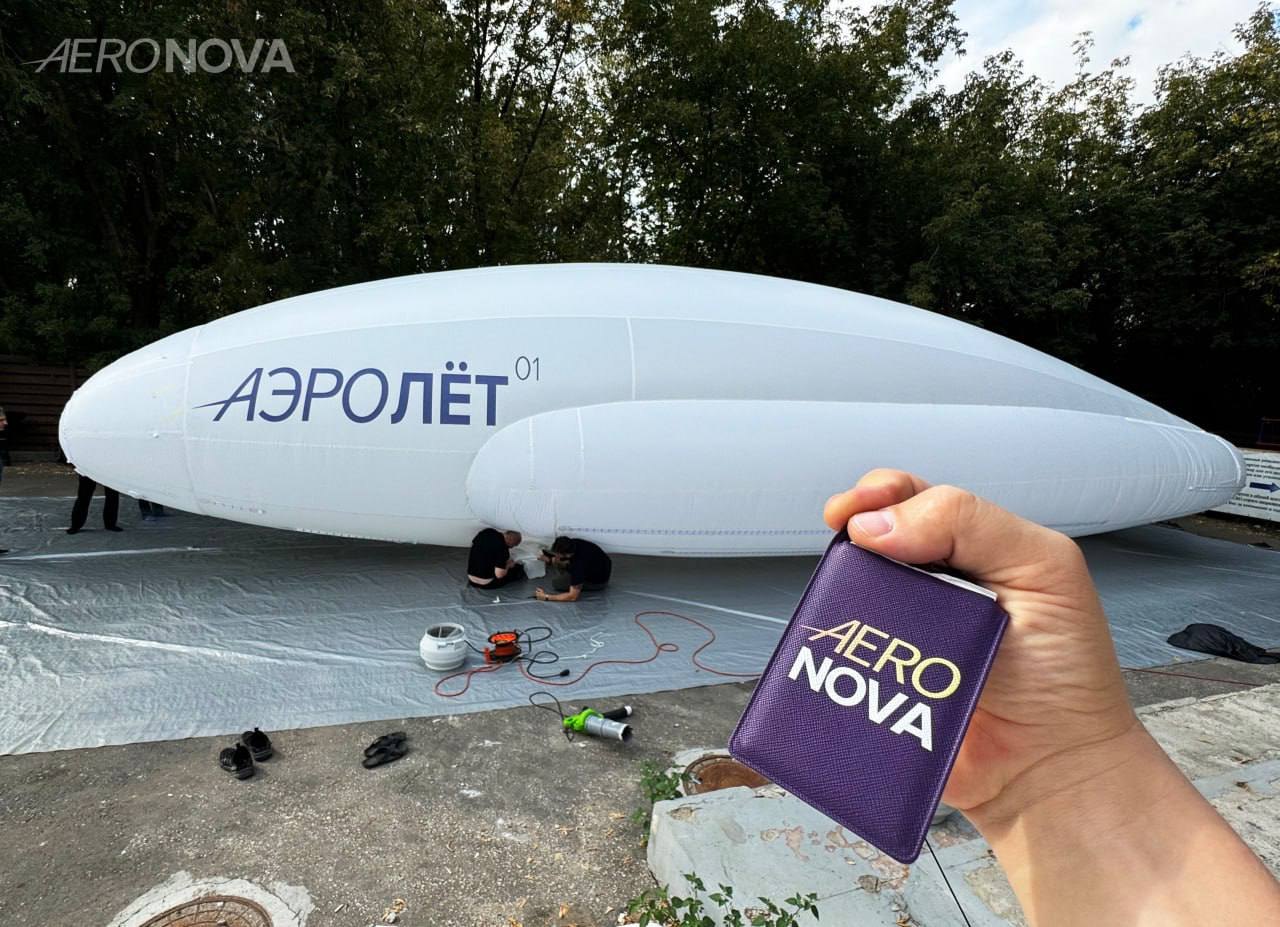
AEROLET-01 — hybrid airship in flight. Flight testing

AEROLET-01 · hybrid aircraft

Lift by two means

An experimental hybrid combining the advantages of an airship and an aircraft, generating lift both aerostatically and aerodynamically. Its shape adds aerodynamic lift on top of aerostatic lift — increasing payload and allowing operation without ballast. Built and in flight testing.

Specifications

Volume190 m³
Payloadup to 100 kg
Rangeup to 300 km
Speedup to 100 km/h
Altitudeup to 2,000 m
Next step

NOVA-2: one platform, three variants

NOVA-2 is not a single aircraft — it is a unified engineering platform. Three variants are built on it. This is the platform from which the entire NOVA line begins to scale.

NOVA-2 — the platform

Volume2,000 m³
Payloadup to 500 kg
Rangeup to 500 km
Speedup to 100 km/h
Altitudeup to 2,000 m
Loiterup to 24 h
Capacity6 seats incl. pilot

NOVA-2E — electric

Being assembled right now

Envelope manufactured and pressure-tested · assembly under way

The first variant in the line, powered by four electric motors. The envelope has been manufactured and pressure-tested with air — assembly is under way.

NOVA-2LL — flying laboratory

Next in line

In development

An unmanned copy of the passenger variant — to validate all systems before people come aboard. Two internal-combustion engines.

NOVA-2PP — passenger, piloted

6 seats including pilot

In development

The passenger variant, 6 seats including pilot. Two internal-combustion engines.

NOVA-2PP gondola — visualisation

Visualisation / concept

Applications

Monitoring & surveillance Infrastructure inspection Mapping & aerial photography Cargo delivery to remote areas Security & rescue operations Government & corporate missions

Passenger and tourist operations — later, after testing and certification.

What's next

Future lineup

NOVA-2 is just the beginning. Next come aircraft of a different scale. The line is in development, and every next aircraft is built on data from the previous one.

DESIGN SPECIFICATIONS · IN DEVELOPMENT

Heavy cargo class

NOVA-8

Heavy cargo class for commercial operations — freight and tourism, in multiple variants tailored to customer requirements.

Volume8,000 m³
Payloadup to 3 t
Rangeup to 2,000 km
Speedup to 135 km/h
Altitudeup to 2,500 m

Flagship of the line

NOVA-35

The culmination of everything proven on earlier models, and the most compact rigid-hull cargo airship in AERONOVA's future line. Built for complex logistics.

Volume35,000 m³
Payloadfrom 10 t
Rangeup to 5,000 km
Speedup to 130 km/h

And this is only the entry into the heavy class. The company's strategic direction is large rigid-hull airships — our goal is to reach payloads of 60 tonnes and beyond. That's the scale we're aiming at.

AERONOVA stratostat

Separate direction

Stratostats & tethered aerostats

Launches are inexpensive, flights are long, and the platform carries heavy equipment — and, unlike an aircraft, generates no vibration, which is critical for precision measurements.

Payloadup to 200 kg
Altitude15–30 km
Driftup to 100 days
📄

Russian Ministry of Industry and Trade licence

Development of aviation technology. Category: lighter-than-air aircraft. Active, perpetual. No. Л007-00102-77/04708388.

🏗

In-house design office

A full-cycle engineering team — from concept to flight testing.

🔧

In-house soft-shell production

Key manufacturing operations performed ourselves — not outsourced.

✈️

Pursuing aviation certification

The next systemic step in the programme.

No. Л007-00102-77/04708388

View the official registry extract
Own production

Envelopes — made in-house

The envelope is the heart of an airship and its most complex element. AERONOVA doesn't outsource it: we run our own line, performing the key soft-shell manufacturing operations ourselves and steadily scaling our production capacity.

AERONOVA team — group photo

By people who have actually flown airships.

AERONOVA is more than 45 professionals: distinguished academics, candidates of science and engineers with decades in aerospace — alongside young specialists who bring fresh perspective. This is a team that isn't meeting aeronautics for the first time today: its members designed, built and flew airships long before AERONOVA existed.

Boris Ivchenko

Boris Ivchenko

Head of Design Office

Vadim Zubkevich

Vadim Zubkevich

Chief Designer, NOVA series

Dmitry Khmel

Dmitry Khmel

Chief Designer, AEROLET series

Fyodor Konstantinov

Fyodor Konstantinov

Chief Technology Officer

Milad Ranai

Milad Ranai

Lead Software Developer

Shamil Arslanov

Shamil Arslanov

Production

AERONOVA is a registered company (OOO AERONOVA, INN 7100032055).A real legal entity behind real aircraft.
How to get involved

Three ways to make this journey together

01 · Watch

Follow the build

Follow how we bring back an entire industry practically from scratch — real footage, behind-the-scenes, engineering, the whole journey from the inside.

02 · Partner

Help the project grow

Help the project grow — spread the word, promote the direction and earn in the affiliate programme.

Stay in the loop

Stay in the loop. Get the big news and footage as it happens.

Real footage, real milestones, real engineering — as it happens. Tell us how you want to be involved and we'll point you in the right direction.

Questions? Use the form to reach us.
Either one works — just one is enough.